I assume that this very issue has been the only one edited by that very branch – at least the International Archives do not dispose of any other. It is slightly larger than the Swiss one (14,5 x 10 cm compared to 12,5 x 9 cm), and it is printed in high quality white paper, whereas its Swiss counterpart is printed in shabby grey recycled paper.
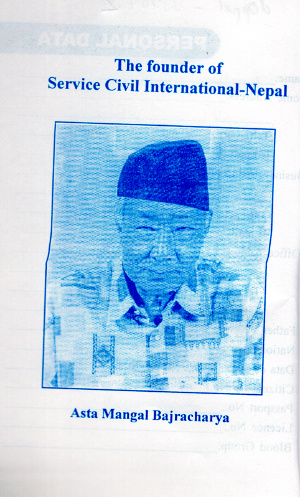
 The Nepalese branch pays tribute to SCI history by publishing the picture of Pierre Ceresole right on page 2 (the Swiss would never show that much traditionalism!), and on page 4 that of its own founder, Asta Mangal Bajracharya (ever heard of him? He looks charismatic, though). Most of the texts, and also the calendar parts, are in English language; just six pages – apparently the translation of the Introduction – are in Nepalese. This may make us believe that the diary was used as a giveaway to SCI friends outside the country, just as the beautiful however strangely smelling wall calendars the same branch had brought all the way to Europe for an ICM a few years later, causing as much joy as laughter among the delegate from all over the world.
However, its most remarkable feature for me as a European is the Directory part of the booklet: Just after the Introduction, and before the Calendar which starts with a list of National Holidays, we are confronted with comprehensive lists of Past National Presidents of SCI-Nepal as well as of the branch’s current Board Members, including a President, a Vice-President, a General Secretary, a Secretary, and a Treasurer. This seems to confirm the picture we have of the high value Asian branches attribute to formal functions, titles, and hierarchy in general. It is not much of a surprise, therefore, that just one page after 31st December, the reader is treated with another list of Presidents: That of the Presidents, and contact addresses, of no less than 17 local SCI Groups, or Units, among them two Women Units, and one Mount Everest Unit. What may be more of a surprise, however, is the following list of Nepalese SCI Volunteers Past & Current, in alphabethical order, some even with their telephone numbers. This list, which is headed by the Life Members and one Honourable Member (hierarchy is still there!), takes 19 pages in total. Whereas for an individual address and telephone directory, only three pages are reserved in the end. The latest edition of the Swiss diary, in contrast, offers SCI and other NGO addresses on six pages, whereas more than twenty pages are reserved for the holder’s individual directory. Doesn’t this difference in priorities reflect the different degrees of individualism in East and West, in South Asia and Central Europe?
Heinz Gabathuler, International Archives Coordinator
In the SCI International Archives, the Diary can be found in file 33104.2.